How to Breathe While Rebounding: A Beginner's Guide to a Comfortable Pace
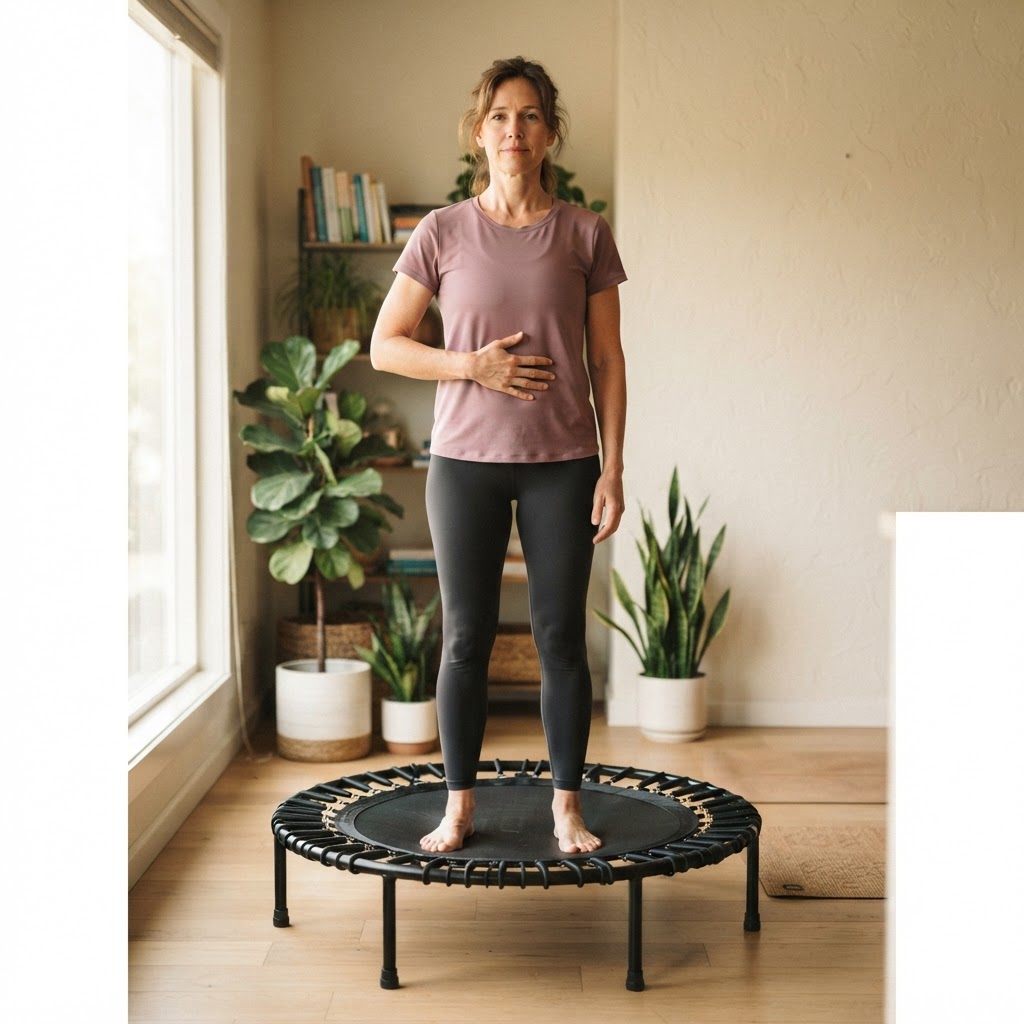
When you are learning to rebound, there is a lot to think about: where your feet belong, how much the mat moves, and what your arms are doing. Breathing can quietly become another thing you try to control perfectly.
I would rather you simplify the movement than force an elaborate breathing pattern. For a beginner session, your breath is useful feedback. It can help you notice when the pace needs to come down.
Start with breathing, not choreography
Before moving, stand securely on stable ground and let your breathing settle. Notice whether your shoulders are lifted or your jaw feels tight. You do not need to take the biggest possible breath or push your stomach outward.
Once you are comfortably positioned near the center of your rebounder, begin with small presses while both feet remain in contact with the mat. Let your breathing continue naturally. If you immediately hold your breath, stop the movement and restart more gently.
Do not practice balance-challenging breathing drills on a moving mat. Keep your eyes open and your attention on your surroundings.
Do you have to breathe through your nose?
No single nose-only rule suits every person or workout. As effort changes, breathing through your mouth or through both your nose and mouth may feel more comfortable. Do not force nose-only breathing if it makes you feel air-hungry.
Likewise, you do not need one inhale for every bounce or a fixed number of bounces per exhale. The mat's rhythm and your breathing rhythm do not have to match. Comfortable, continuous breathing matters more than a count.
If you have asthma or another condition affecting breathing, follow your clinician's exercise and medication guidance rather than replacing it with a general breathing tip.
Use the talk test as a practical check
During an easy beginner routine, try saying a complete sentence aloud. If you can speak comfortably, the effort is more likely to be manageable for that session. If you can say only a few words before needing air, reduce the effort.
The talk test is an informal intensity check, not a medical assessment or a precise heart-rate measurement. Comfortable conversation also does not mean you should ignore pain, dizziness, or other symptoms.
Try these adjustments one at a time:
- Make the downward press smaller.
- Slow your movement instead of following the music.
- Lower your arms if overhead movements increase the effort.
- Replace marching with feet-on-the-mat pressing.
- Pause and let the mat settle before stepping off if needed.
What if you keep holding your breath?
Breath-holding can happen when a movement feels unfamiliar or when you brace harder than necessary. First, remove complexity. Stop the arm sequence, shorten the movement, and return to a position that feels secure.
Relax your jaw and shoulders. Think about allowing a gentle exhale instead of squeezing out all your air. Avoid repeatedly taking very large, fast breaths; more deliberate breathing is not automatically better breathing.
If breath-holding returns every time you move, practice standing comfortably on the still mat or choose movement on stable ground instead. There is no benefit in progressing before you feel ready.
A simple breathing check-in
For your next session, use three checkpoints: before starting, partway through, and before finishing. Ask yourself: Can I speak comfortably? Am I tightening my shoulders? Would a smaller movement feel better?
You do not need to monitor every breath. These brief check-ins are simply a way to keep the session responsive to how you feel.
Stop for unusual or worsening breathlessness, dizziness, pain, or pelvic-floor symptoms. Seek urgent medical help for chest pain, fainting, or severe breathing difficulty. Persistent or unexpected breathing symptoms deserve medical advice, not a harder workout.
Keep the next workout simple
Try the feet-on-the-mat beginner routine when you want fewer movements to think about. My aim is not perfect breathing technique. It is helping you recognize a pace you can manage without strain.
For guided sessions, explore my free 30-day beginner plan. Still choosing equipment? Take the Rebounder Match Quiz or visit the rebounder buying guide and deals.
This article provides general fitness education and does not diagnose or treat breathing problems.
Comments (0)
No comments yet. Be the first to share your thoughts!