Rebounding for Balance and Coordination: A Beginner Progression
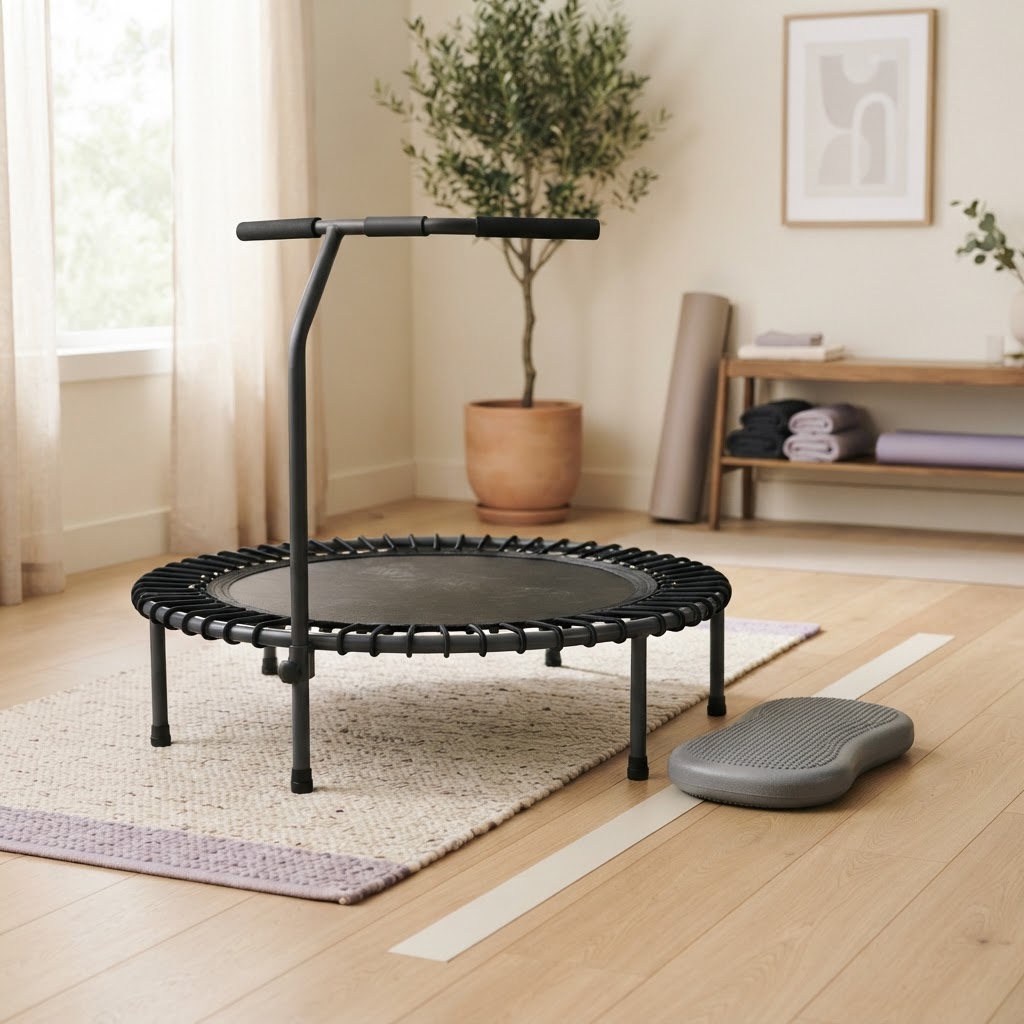
Why a rebounder challenges balance
A rebounder is a moving surface. Even when your feet stay in contact with the mat, your ankles, legs, hips, trunk, vision, and inner-ear systems work together to keep you organized over your base of support.
That challenge may help train coordination, but it also means beginners should not assume a mini trampoline is automatically easy or safe.
Set up for success
Place the rebounder on a level, non-slip floor with clear space around it. Use a securely installed support bar if needed. Look toward a stable point ahead instead of watching your feet throughout the workout.
Practice stepping onto and off the rebounder before bouncing. Make sure you can stand comfortably and stop a movement on command.
A five-step balance progression
1. Weight shifts
With feet about hip-width apart, slowly move pressure from left to right and forward to back. Keep both feet down.
2. Health bounce
Press gently into the mat without leaving it. Keep the movement small and your knees soft.
3. Marching
Lift one heel or foot at a time. Use the handlebar lightly rather than hanging from it.
4. Simple direction changes
Try controlled side steps, heel taps, or a small turn of the torso while the feet remain predictable.
5. Brief unsupported practice
If appropriate, reduce hand support for a few seconds while maintaining a small, controlled movement. Return your hand before form changes.
Quality matters more than duration
Balance practice becomes less useful when fatigue causes rushing, gripping, or repeated loss of position. Short, focused rounds are enough. Rest between attempts and keep advanced choreography for later.
Who should get individual guidance?
A history of falls, dizziness, neurological conditions, vision changes, significant weakness, or medication-related balance effects deserves professional guidance. Stop for dizziness, unusual symptoms, or repeated loss of control.
The teacher’s takeaway
The goal is not to prove that you can bounce without holding on. The goal is to improve control while using the level of support that lets you practice safely. Confidence should grow from skill, not pressure.
Keep learning
Comments (0)
No comments yet. Be the first to share your thoughts!