Rebounding for Joint Pain: What Low-Impact Really Means
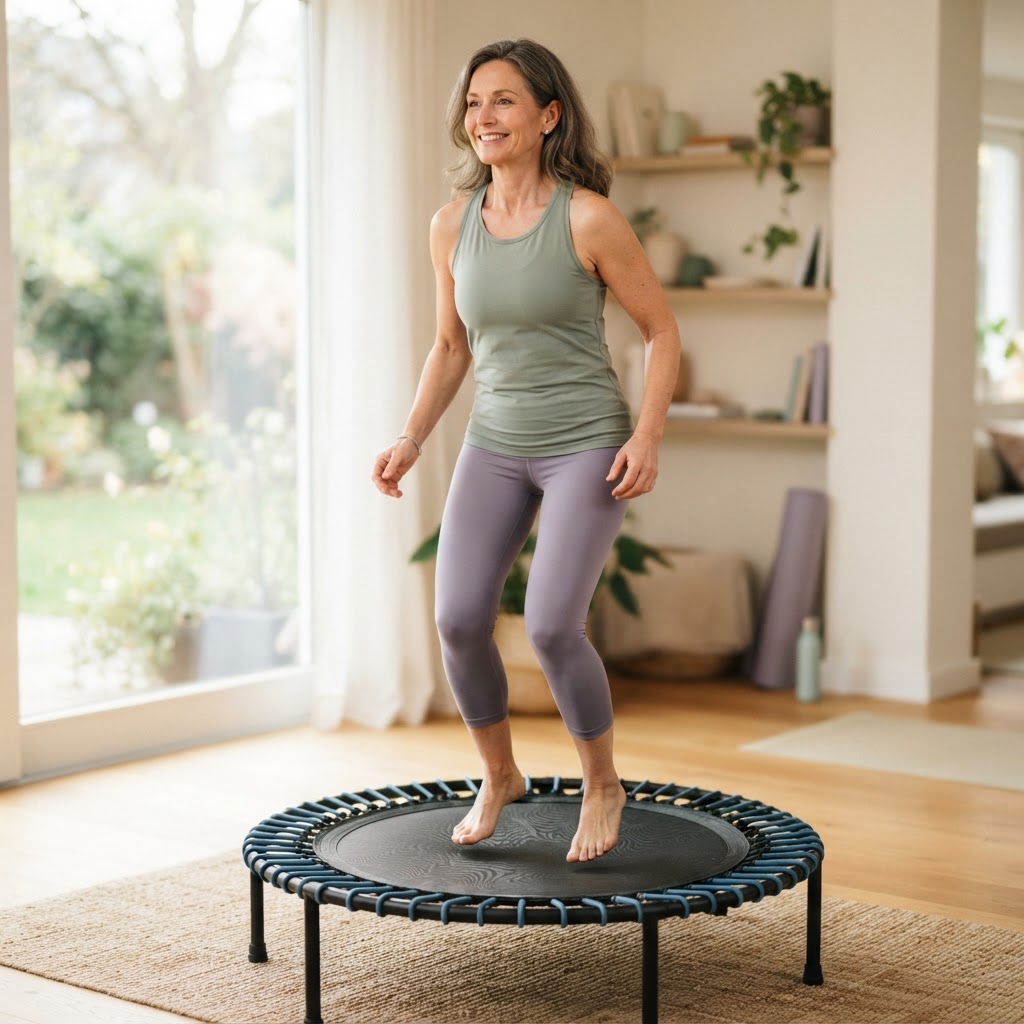
Low-impact is a description, not a guarantee
Rebounding is often called low-impact because the flexible mat absorbs and returns some of the force that would otherwise meet a rigid floor. Your feet can remain in contact with the mat during a basic health bounce, and many people find that style more comfortable than jogging.
That does not mean rebounding is automatically comfortable for every knee, hip, ankle, or back. “Low-impact” describes a general mechanical feature. It does not promise a specific result for a specific body.
What may make rebounding feel joint-friendly
A controlled bounce can be useful for people who want rhythmic movement without repeated foot strikes on pavement. The mat, bungee or spring system, rebounder firmness, and your technique all influence how the movement feels.
Joint comfort may be supported by:
- Keeping the bounce small while learning
- Pressing down into the mat instead of chasing height
- Keeping knees softly bent rather than locked
- Using a stable support bar when balance is uncertain
- Choosing a cadence you can control
- Stopping before fatigue changes your alignment
A softer bounce is not always better. If the mat is so soft that you struggle to control your position, your muscles may work harder to stabilize you. The useful setting is the one that lets you move smoothly and confidently.
Start with the health bounce
Stand tall with feet about hip-width apart. Shift your weight gently into the mat without letting your feet leave it. Keep your gaze forward and ribs stacked over your pelvis. Begin with one or two minutes, then step off and notice how your body responds.
If that feels steady, repeat another short round. Progress duration before adding bigger movement. A small bounce performed well is not a lesser workout; it is the foundation.
When to get individual guidance
New, sharp, worsening, or unexplained pain deserves professional evaluation. If you are recovering from surgery, managing a diagnosed condition, or have been advised to limit impact, ask your qualified healthcare professional whether rebounding fits your situation.
A coach can help with technique, but a coach does not diagnose the cause of pain.
The teacher’s takeaway
Rebounding can be useful for joint-conscious exercise because the surface and movement can be adjusted. The goal is not to prove that bouncing is always gentle. The goal is to find a version of movement your body can perform with control, confidence, and an appropriate recovery response.
Comments (0)
No comments yet. Be the first to share your thoughts!