Rebounding vs. Treadmill: Which Workout Fits Your Goals?
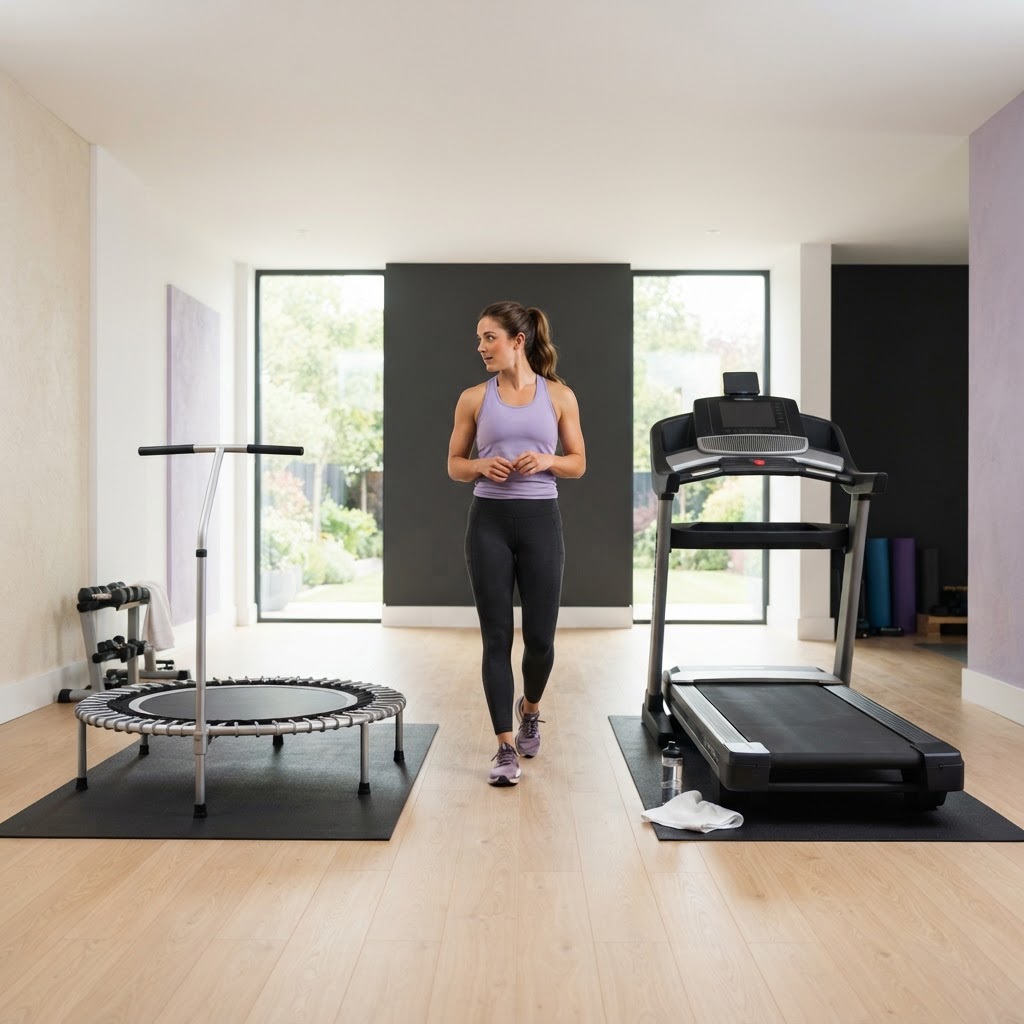
There is no universal winner
A rebounder and a treadmill can both support cardiovascular exercise. The better choice is the one that fits your goals, space, balance, joint comfort, and willingness to use it consistently.
Rather than asking which machine is “best,” compare the job each one does well.
Impact and surface feel
A treadmill provides a moving but relatively firm surface. Walking can be controlled and familiar, while running adds repeated foot strikes. Speed and incline make the workload easy to measure.
A rebounder uses a flexible mat. A basic health bounce can keep the feet in contact with the surface, while higher bounces and faster combinations increase demand. Some people prefer the softer feel; others find the changing surface requires more stabilization than expected.
Balance and coordination
Treadmill walking follows a familiar gait pattern, but the moving belt requires attention. Holding the rails continuously can change posture and reduce the natural arm swing.
Rebounding asks you to control movement in several directions on an unstable surface. That can be useful for coordination practice, but it can also be challenging for a beginner. A support bar and a small bounce can make the learning process more manageable.
Measuring intensity
Treadmills display speed, incline, time, and estimated distance. Those numbers make progressive planning straightforward.
Rebounders usually offer fewer measurements. You can track session time, perceived effort, heart rate, cadence, or the complexity of movements instead. Do not assume a rebounder session is harder simply because it feels unfamiliar.
Space, noise, and convenience
A rebounder has a smaller footprint than most treadmills and may be easier to move, although “foldable” does not always mean quick to fold. Noise depends on the frame, springs or bungees, floor, and workout style.
A treadmill takes more permanent space and needs power unless it is manual. It may suit people who want indoor walking or running without learning new choreography.
Match the tool to the goal
Choose a treadmill when your priority is walking or running specificity, precise pace control, or incline training. Choose a rebounder when you enjoy rhythmic, low-height bouncing, varied movement patterns, and compact home exercise.
You can also use both. Ten minutes of bouncing and twenty minutes of walking is a perfectly respectable plan.
The teacher’s takeaway
Neither tool wins every category. The useful question is: which activity can you perform safely, progress gradually, and repeat often enough to matter? The equipment that gets used has a remarkable advantage over the equipment serving as an expensive clothes rack.
Comments (0)
No comments yet. Be the first to share your thoughts!