Is Rebounding Better Than Walking for Women Over 40?
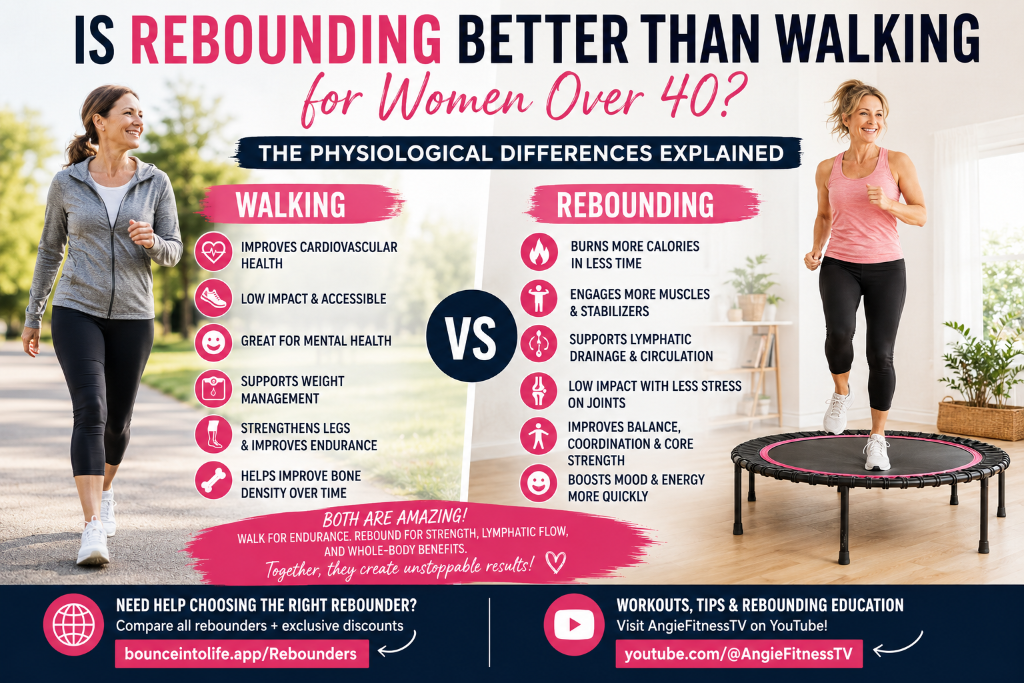
The Physiological Differences Between Rebounding and Walking — And Why So Many Women Are Making the Switch
Walking has long been considered one of the best forms of exercise for overall health.
And honestly?
Walking is AMAZING.
But recently, more women over 40 are discovering rebounding — and asking an important question:
Is rebounding actually BETTER than walking?
The answer is not completely black and white.
Because physiologically, rebounding and walking affect the body VERY differently.
And understanding those differences can help women choose the right type of movement for THEIR body, goals, joints, hormones, and lifestyle.
First… Walking Is Fantastic
Let's start here.
Walking:
- ✔️ Improves cardiovascular health
- ✔️ Supports mental health
- ✔️ Helps circulation
- ✔️ Supports weight management
- ✔️ Is accessible for most people
- ✔️ Reduces sedentary behavior
- ✔️ Can improve longevity
Walking is one of the healthiest things many people can do daily.
But rebounding introduces something unique physiologically that walking does not fully replicate.
What Makes Rebounding Physiologically Different?
Rebounding creates acceleration + deceleration forces.
Every bounce creates changing gravitational loads throughout the body.
When you bounce upward: your body experiences reduced gravitational force.
When you land: your body experiences increased force loading.
This constant change challenges:
- Muscles
- Connective tissue
- Stabilizers
- Balance systems
- Coordination systems
- Cardiovascular demand
…in a way walking does not fully duplicate.
Rebounding Requires More Stabilization
Walking is primarily forward movement.
Rebounding requires:
- Multidirectional stabilization
- Ankle control
- Hip stabilization
- Core engagement
- Postural corrections
- Balance reactions
Even basic rebounding activates:
- Feet
- Calves
- Hips
- Glutes
- Deep core muscles
- Spinal stabilizers
Many women are surprised how much more muscular rebounding feels compared to walking.
Why Rebounding FEELS Harder Faster
Many people notice: "I only bounced for 10 minutes and felt exhausted."
Why?
Because rebounding can increase cardiovascular demand quickly due to:
- Unstable surface training
- Full-body muscular recruitment
- Rapid stabilization demands
- Vertical force changes
Even gentle rebounding can elevate heart rate rapidly.
Rebounding Is Often Lower Impact Than People Expect
This surprises many beginners.
A properly designed rebounder can absorb a significant amount of landing force compared to hard surfaces.
That means many women experience:
- ✔️ Less pounding
- ✔️ Less repetitive pavement impact
- ✔️ Less stress on knees
- ✔️ Less stress on hips
- ✔️ More comfort than jogging
This is especially important for:
- Women over 40
- Joint-sensitive individuals
- People recovering from injuries
- Menopause-related joint discomfort
The Lymphatic System Discussion
One reason rebounding became so popular is its potential relationship with lymphatic movement.
The lymphatic system relies heavily on movement.
Many rebounding enthusiasts believe the rhythmic up-and-down motion may help support:
- Circulation
- Fluid movement
- Wellness routines
- Daily movement patterns
This has made rebounding especially popular in wellness communities, women's fitness groups, and low-impact exercise spaces.
Walking and Rebounding Actually Work BEAUTIFULLY Together
This is important.
It is NOT: walking OR rebounding.
Many women thrive using BOTH.
Example:
- 🚶 Walking outdoors for mental wellness and daily steps
- 🏃 Rebounding for cardio, strength endurance, balance, lymphatic movement, and low-impact conditioning
Together, they can complement each other extremely well.
Why Women Over 40 Are Drawn to Rebounding
Many women over 40 begin searching for:
- Low impact cardio
- Home workouts
- Joint-friendly exercise
- Efficient workouts
- Fun movement
- Sustainable fitness
Rebounding checks many of those boxes.
Women often love that rebounding:
- ✔️ Feels playful
- ✔️ Can be done indoors
- ✔️ Takes little space
- ✔️ Is time efficient
- ✔️ Feels easier on joints
- ✔️ Can improve consistency with exercise
Does the Rebounder You Buy Matter?
YES.
And this is where many women get overwhelmed.
Different rebounders create VERY different:
- Bounce mechanics
- Landing absorption
- Stability patterns
- Joint loading
- Workout feel
Some rebounders feel soft and therapeutic. Others feel firm and athletic.
The right rebounder depends on:
- Your goals
- Body weight & height
- Injuries
- Fitness level
- Balance ability
- Budget
- Workout style
Need Help Choosing a Rebounder?
I created a full rebounder guide comparing entry-level, premium, medium bounce, firm bounce, and therapeutic rebounders — including options specifically for beginners and women over 40.
👉 Rebounder Buying Guide + Discounts →
Follow AngieFitnessTV for Rebounding Workouts & Education
For beginner rebounding workouts, mini trampoline education, low impact cardio, women over 40 fitness, lymphatic rebounding workouts, and wellness inspiration, visit:
👉 AngieFitnessTV YouTube Channel →
Final Thoughts
Walking is one of the BEST things you can do for your health.
But rebounding introduces unique physiological challenges that many women find:
- More engaging
- More efficient
- Easier on joints
- More fun
- More motivating
And sometimes… finding movement you ENJOY is what matters most.
Comments (0)
No comments yet. Be the first to share your thoughts!