Top 10 Reported Benefits of Rebounding: Why Begin a Rebounding Program?
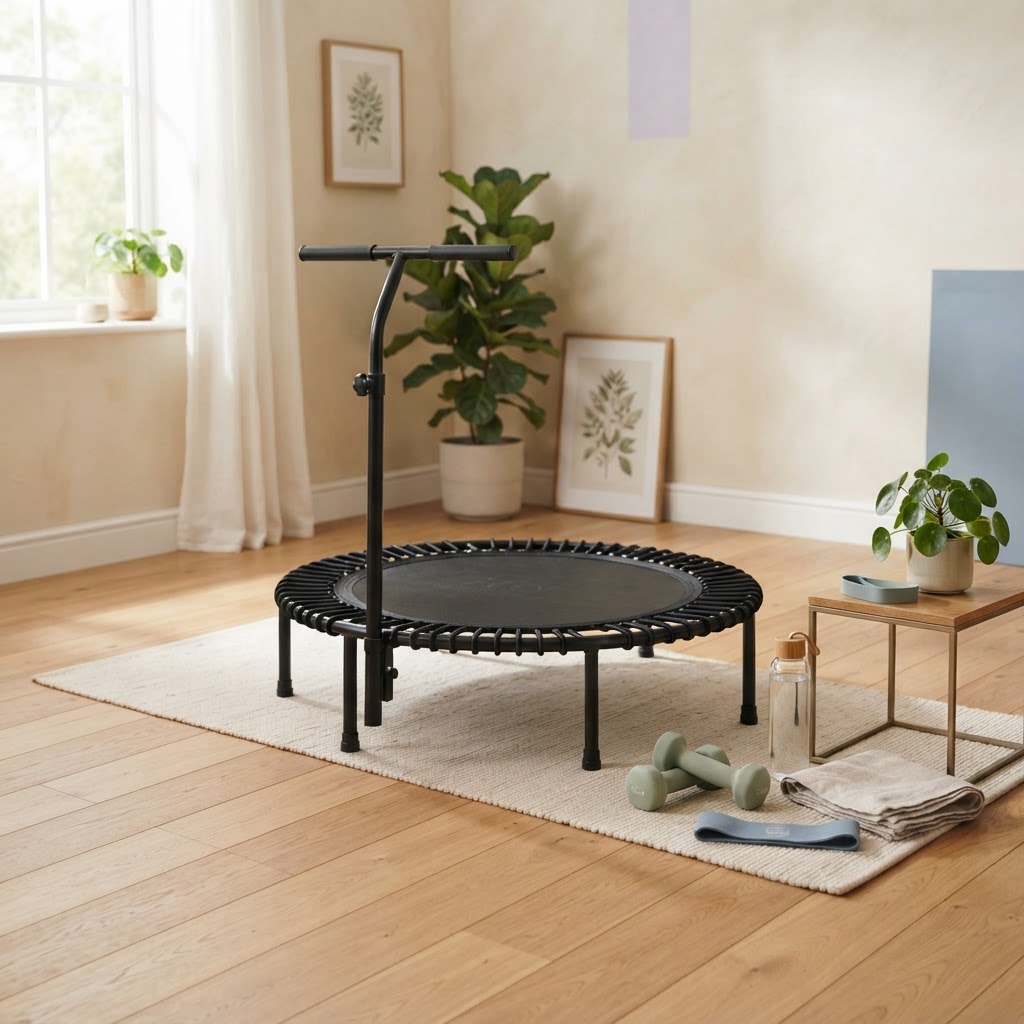
Rebounding is exercise performed on a mini trampoline. You can begin with a gentle health bounce—keeping your feet on the mat—and gradually add walking, basic steps, strength exercises, or faster cardio.
People often ask whether rebounding is better than walking, running, cycling, or strength training. The honest answer is that no single exercise format does everything. Rebounding is valuable because it can combine cardio, balance, coordination, and muscular work in one small home-based workout.
Below are 10 commonly reported benefits, what current research suggests, and what rebounding should not be expected to do.
Ready for a simple start? Join my Beginner 30-Day Rebounding Program. If you still need equipment, take the free Rebounder Match Quiz.
Educational note: This article is general fitness information, not medical advice. Reported benefits vary by person, workout intensity, consistency, health status, and rebounder setup. Research on mini-trampoline exercise is promising but still smaller than the evidence base for walking, conventional strength training, and other established exercise formats.
1. It may improve cardiovascular fitness
Rebounding can raise your heart rate enough to count as moderate or vigorous aerobic exercise, depending on the movement and pace.
An American Council on Exercise study found that a structured mini-trampoline workout produced heart-rate and energy-expenditure levels capable of improving cardiorespiratory fitness. Participants also perceived the workout as easier than its measured intensity suggested.
Why this matters
Your heart and lungs benefit from regular aerobic activity. A gentle beginner may start with short intervals, while an experienced exerciser can use faster footwork or intervals for a more demanding session.
Keep it simple: You should be able to speak in sentences during moderate exercise. Slow down if you cannot control your breathing or movement.
2. It offers a lower-jarring alternative to running
The flexible mat and suspension absorb and return part of the force created by each landing. Many people therefore report that rebounding feels less jarring than running on pavement or a treadmill.
Lower impact does not mean zero impact or guaranteed pain-free exercise. Technique, rebounder quality, suspension firmness, body weight, footwear choice, and health conditions all affect comfort.
Compared with running
- Rebounding: More forgiving surface, indoor convenience, added balance challenge
- Running: Easier to do without equipment, more specific preparation for running events, straightforward outdoor distance tracking
Choose the activity your body tolerates and that matches your goal.
3. It trains balance and coordination
The moving mat continually asks your body to organize posture and control its center of mass. Even a small health bounce requires your ankles, knees, hips, trunk, eyes, and inner-ear balance system to work together.
Research reviews have reported improvements in balance, motor performance, and lower-limb function in several groups. Results cannot be applied equally to everyone, but balance training is one of the clearest reasons rebounding differs from a stationary cardio machine.
Begin safely
Use small movements near a stable support. Consider a manufacturer-approved handlebar when appropriate. A support bar can add a point of contact, but it does not prevent every fall.
4. It engages the legs and core
Pressing into the mat and controlling the return activates the calves, thighs, hips, and trunk. Changing stance, direction, tempo, or arm position can alter the challenge.
Rebounding may improve muscular endurance and control, especially for beginners. It does not replace progressive strength training with appropriately challenging resistance.
Best combination
Use rebounding for cardio and coordination, then include strength work for major muscle groups at least twice per week when appropriate for you.
5. It may support bone health through weight-bearing movement
Unlike cycling and swimming, rebounding is performed while supporting your body weight. Repeated loading may provide a bone stimulus, and some small studies have reported positive bone-related outcomes.
However, the ideal type and amount of loading for bone health varies. People with osteoporosis, fracture history, significant balance limitations, or joint replacement should not assume bouncing is automatically appropriate.
Compared with cycling or swimming
- Rebounding: Weight-bearing and balance-demanding
- Cycling: Low-impact seated cardio with less balance demand
- Swimming: Buoyant full-body exercise with very little weight-bearing load
These formats can complement each other rather than compete.
6. It can make exercise feel more enjoyable
The best workout is not only effective—it is one you will repeat. Many people describe bouncing as playful, energizing, and less repetitive than traditional cardio.
In the ACE study, participants worked at a meaningful intensity while rating the effort lower than researchers expected. Enjoyment and lower perceived effort may help some people stay consistent.
Enjoyment is personal. If you dislike bouncing, walking, dancing, cycling, or another format may be a better long-term choice.
7. It may support weight management
A rebounder workout uses energy. When combined with nutrition, sleep, stress management, and consistent activity, it may contribute to weight management and changes in body composition.
A recent review of rebound exercise research found studies reporting improvements in body composition and waist measurements. The studies were limited and varied, so rebounding should not be presented as a guaranteed or unusually rapid weight-loss method.
What matters most
Workout duration, intensity, body size, fitness level, and consistency influence energy expenditure. No reliable rule says that a few minutes of bouncing always equals a much longer run.
8. It may support circulation and regular movement breaks
Rhythmic muscle contractions help move blood back toward the heart, just as they do during walking and other exercise. A rebounder can make short indoor movement breaks convenient, especially when weather, time, or location makes an outdoor workout difficult.
Movement also supports normal lymph flow. The lymphatic system depends partly on muscle activity and breathing because it does not have a central pump like the heart.
Important clarification
Rebounding does not “detox” the body or cure lymphatic disease. The liver, kidneys, lungs, digestive system, and lymphatic system perform their own normal functions. Anyone with diagnosed lymphedema should follow guidance from a qualified clinician.
9. It can develop body awareness and movement confidence
The rebounder gives immediate feedback. If you shift too far from the center, stiffen excessively, or lose rhythm, you feel it quickly. Controlled practice may improve timing, posture awareness, foot placement, and confidence with movement.
This benefit depends on starting at the right level. Large jumps and complex choreography are not required. A small controlled bounce can be challenging enough for a beginner.
10. It may support mood, stress relief, and energy
Like other forms of physical activity, rebounding may improve mood, reduce feelings of stress, and increase perceived energy. Music, rhythm, and the playful nature of bouncing can make the experience especially uplifting for some people.
Rebounding is not a treatment for anxiety, depression, chronic fatigue, or another medical condition. It can be one supportive part of a broader health plan when appropriate.
How rebounding compares with other exercise formats
Rebounding vs walking
Rebounding may offer: More balance challenge, more movement variety, and higher intensity in a small indoor space.
Walking may offer: No special equipment, easier social participation, outdoor time, and a lower learning curve.
Best choice: Walking is often the simplest place to begin. Rebounding is useful when you want variety or convenient indoor cardio.
Rebounding vs running
Rebounding may offer: A softer-feeling landing surface and less repetitive forward impact.
Running may offer: Sport-specific endurance, outdoor distance, and stronger preparation for walking or running events.
Best choice: Rebound when you prefer the elastic surface; run when running performance is the goal and your body tolerates it.
Rebounding vs cycling
Rebounding may offer: Weight-bearing movement, balance training, and upright whole-body coordination.
Cycling may offer: Stable seated cardio, easy resistance control, and less demand on balance.
Best choice: Cycling may suit people who need more support. Rebounding adds a balance and weight-bearing component.
Rebounding vs strength training
Rebounding may offer: Cardio, rhythm, coordination, and muscular endurance.
Strength training may offer: Greater ability to progressively load muscles and build strength.
Best choice: Do both. Rebounding should complement—not replace—well-designed strength training.
Rebounding vs high-impact group exercise
Rebounding may offer: A more forgiving surface and the ability to reduce movement size while still following rhythm.
Floor-based classes may offer: More lateral travel, equipment variety, and skills that transfer directly to ground movement.
Best choice: Select the environment where you can control technique and intensity.
Why begin a rebounding program?
A program gives you structure. Instead of stepping onto the rebounder and wondering what to do, you follow a gradual plan that allows balance, coordination, and confidence to develop.
A beginner program can help you:
- Start with short, manageable sessions
- Learn posture and basic foot positions
- Increase time and intensity gradually
- Build consistency before complexity
- Notice how your body responds
- Avoid doing too much too soon
You do not need to jump high. The goal is controlled movement and steady progress.
A simple beginner progression
Week 1: Learn control
Use a gentle health bounce, marching, and basic weight shifts. Keep sessions short and stop before technique becomes sloppy.
Week 2: Build time
Add a few minutes or repeat short work-and-rest intervals. Continue using simple movements.
Week 3: Add variety
Introduce appropriate arm movements, wider stances, or gentle directional changes.
Week 4: Build a routine
Combine cardio, balance, and simple strength patterns at a level you can repeat consistently.
My Beginner 30-Day Rebounding Program provides a clear place to start without guessing.
Who should get professional guidance first?
Speak with an appropriate healthcare professional before beginning if you have significant balance problems, osteoporosis, recent surgery, joint replacement, uncontrolled cardiovascular concerns, neurological conditions, pregnancy-related concerns, pelvic floor symptoms, lymphedema, unexplained dizziness, or pain with exercise.
Stop and seek guidance if you experience chest pain, faintness, severe shortness of breath, new neurological symptoms, or sharp and worsening pain.
The bottom line
Rebounding can provide effective cardiovascular exercise while also challenging balance, coordination, lower-body endurance, and core control. It may feel more enjoyable and less jarring than some ground-based exercise, and its small indoor footprint can make consistency easier.
It is not a cure, a guaranteed weight-loss shortcut, or a replacement for every other type of movement. A balanced fitness routine can include rebounding, walking, strength training, mobility work, and other activities you enjoy.
If you need help selecting equipment, take my free Rebounder Match Quiz. If your rebounder is ready, begin with the Beginner 30-Day Rebounding Program and progress one controlled session at a time.
Research referenced
- American Council on Exercise-sponsored research on mini-trampoline workout intensity and energy expenditure
- Bhattacharya and colleagues’ NASA-supported research comparing body acceleration and oxygen uptake during trampoline exercise and treadmill running
- A 2024 scoping review of rebound exercise in rehabilitation, which found promising outcomes while emphasizing the need for more research
Comments (0)
No comments yet. Be the first to share your thoughts!