Which Rebounder Should I Buy? Let the Rebounder Match Quiz Take Out the Guesswork
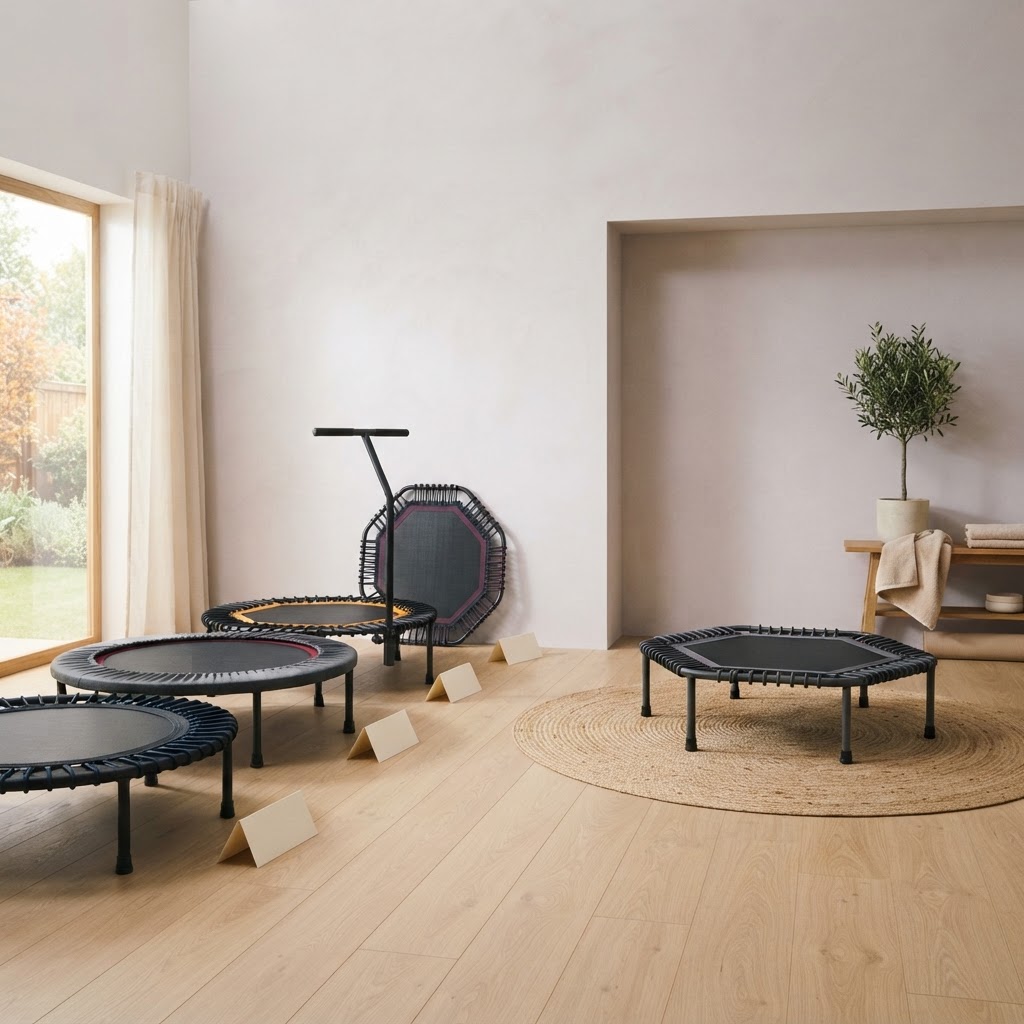
Buying a rebounder can become confusing very quickly
At first, buying a rebounder sounds simple: choose a mini trampoline and start bouncing. Then the questions begin.
Should you buy bungees or springs? Is a 40-inch frame large enough? Do you need a 48-inch model for more movement room? Is the advertised weight limit appropriate for real exercise? Will a soft bounce feel comfortable or difficult to control? Do you need a handlebar? Is the model actually available in your country? And how much do you need to spend to get something dependable?
Online listings often make every model sound perfect for everyone. They are not. A rebounder that suits a shorter beginner in a small apartment may not suit a taller person who wants wide strength movements. A model sold at a good price in the USA may be unavailable or poor value after shipping to Canada, the UK, or Australia.
That confusion is why I created the Rebounder Match Quiz.
Four questions, about one minute
The quiz does not ask you to understand every technical specification before you begin. It asks four practical questions that directly affect which rebounders are sensible choices for you.
1. Where are you shopping?
You can choose USA, Canada, UK, or Australia.
Country matters because rebounder availability, retailer links, shipping, pricing, warranties, voltage-free accessories, and discount arrangements vary by region. A recommendation is not useful if the model cannot be purchased where you live.
The quiz starts with location so it can focus on options intended for your market instead of showing a generic worldwide list.
2. How much movement room do you want?
Your height and preferred movement space help determine whether a compact frame may feel sufficient or whether a roomier mat should be prioritized.
A smaller rebounder may be easier to carry and store. A larger rebounder may provide more confidence for wider stances, side steps, jumping-jack patterns, strength work, and varied choreography. Neither is automatically better; the right choice depends on your body, home, and workout style.
The quiz separates these needs instead of assuming every beginner wants the smallest model.
3. What is your weight range?
Weight capacity should never be treated as a decorative number. The quiz uses your range to show rebounders with enough verified capacity.
This is important because product listings may use different types of weight claims, and model sizes or bungee configurations can have different limits. A careful match should leave an appropriate margin rather than recommending a model simply because it is popular.
Your answer stays private in your browser. No account is needed.
4. Which price level feels right?
The quiz offers three useful levels:
- Entry: the lowest trusted price
- Best Value: quality without unnecessary overspending
- Premium: more space, adjustment, or performance features
This makes budget part of the decision from the beginning. It also helps separate “least expensive” from “best value.” A slightly higher upfront cost may make sense when it provides a better frame size, more suitable bounce, stronger warranty, replacement parts, or a design you are more likely to use consistently.
Many brands also offer payment options at checkout, although terms and eligibility vary.
What the quiz takes off your plate
Without a matching tool, shoppers may open dozens of tabs and try to compare products with inconsistent descriptions. One listing emphasizes frame diameter, another focuses on weight capacity, and another talks about softness without explaining who may prefer it.
The Rebounder Match Quiz organizes the decision around four questions you already know the answers to. It then narrows the field so you can compare a smaller, more relevant set of choices.
It helps reduce guesswork around:
- Regional availability
- Compact versus roomier movement space
- Verified user capacity
- Entry, best-value, and premium budgets
- Models that better fit the combination of your answers
The result is not “the one rebounder every person should buy.” It is a more useful shortlist for you.
Why I built it for four countries
My rebounding community is not limited to one country. Shoppers in the USA, Canada, the UK, and Australia often see different models, prices, shipping choices, and brand support.
A USA-only buyer’s guide can send a Canadian shopper toward an unavailable listing. A UK recommendation may not make financial sense after international shipping to Australia. The quiz accounts for location first so the recommendations begin in the right market.
The quiz is private and does not require an account
You can answer the four questions without creating an account. The site explains that your answers remain private in your browser.
That means you can use the matcher as a decision tool without submitting your name or email. You can also change an answer and compare how more movement room, a different budget, or another weight range changes the options.
What to do with your results
Once you receive your matches, do not rush straight to checkout. Use the shortlist to make a final careful comparison.
For each recommended model, confirm:
- The exact model and size in your cart
- Current user weight limit
- Frame and usable mat dimensions
- Bungee or spring configuration
- Whether a support bar is included or optional
- Folding and storage requirements
- Warranty, trial, and return terms
- Replacement-part availability
- Current price, shipping, and discount details
Product information can change. The seller’s current page and manual should always be your final source for specifications and safe use.
What the quiz does not promise
The matcher is an educational buying tool, not a medical assessment and not a guarantee that one model will feel identical to every user.
If you have significant balance concerns, pain, a recent injury or surgery, pregnancy, or medical advice to limit impact, ask a qualified healthcare professional whether rebounding is appropriate for you. A handlebar can provide a point of contact, but it does not remove fall risk or replace individual guidance.
Why a match is better than a popularity list
A “top ten rebounders” list can be useful for learning what exists, but popularity does not answer the questions that matter most:
- Can you buy it in your country?
- Does it have enough capacity?
- Will the mat feel roomy enough?
- Does it fit your available space?
- Is it within your real budget?
The best rebounder is not the model with the loudest advertising. It is the one that appropriately fits your body, space, goals, location, and budget—and that you feel comfortable using consistently.
Ready to stop comparing endless listings?
Answer four simple questions and let the matcher narrow the choices for you. It takes about one minute, requires no account, and supports shoppers in the USA, Canada, UK, and Australia.
Find My Rebounder with Angie’s Rebounder Match Quiz
Keep learning
Comments (0)
No comments yet. Be the first to share your thoughts!