Rebounding in a Small Space: How to Set Up a Beginner-Friendly Workout Area
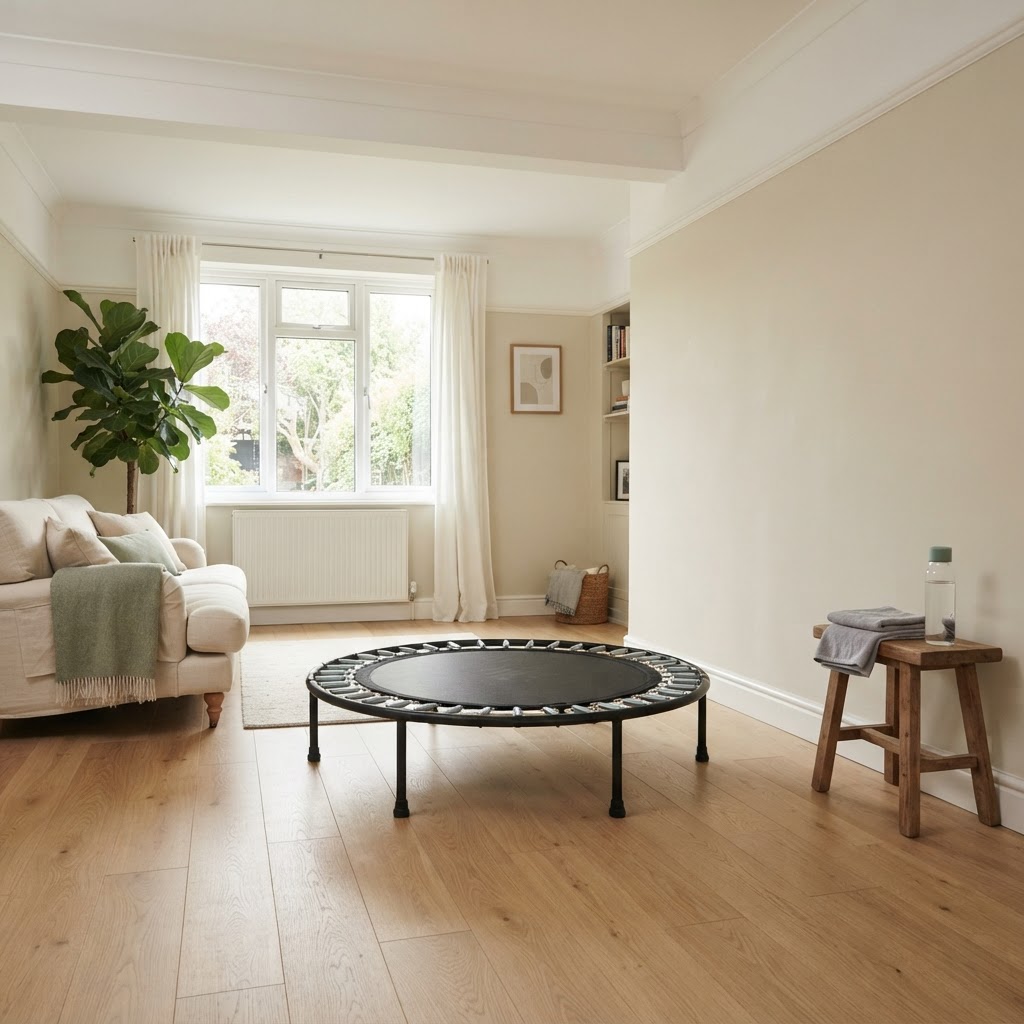
A rebounder can look compact in a product photo and still need more room than you expect once you start moving. The frame is only one part of the space calculation. Your body, your arms, and the area needed to step on and off matter, too.
When I think about a beginner-friendly home setup, I start with a simple question: Can you move without having to protect yourself from the room? If you are watching a coffee-table corner instead of your footing, the setup needs another look.
Measure the usable area, not just the frame
Read the manufacturer's required clearance around and above your specific model. There is no universal distance that makes every rebounder, user, and movement safe.
Measure the whole assembled footprint, including any handlebar or protruding parts. Then account for the required clear area and a safe way to step on and off. A corner that stores the equipment neatly may not be a suitable workout location.
If you cannot meet the equipment's clearance requirements, choose another location or a different activity. Making your bounce smaller is not a substitute for the required safe space.
Look up before you look down
Ceiling height needs to accommodate your height on the rebounder, the movement you plan to do, and the manufacturer's overhead-clearance guidance. Do not calculate from floor level alone.
Check for ceiling fans, hanging lights, beams, sloped ceilings, and open cabinet doors. Keep away from ceiling fans entirely rather than relying on remembering to switch one off. Do not test overhead clearance by bouncing toward an obstacle.
For beginner sessions, low arms and small movements can simplify coordination, but they do not make an unsuitable ceiling safe.
Choose a stable, level surface
Follow the manufacturer's flooring and protective-mat instructions. The rebounder should sit level, with its intended supports securely contacting the floor and no rocking or sliding.
Do not improvise by stacking towels or loose cushions under individual legs. Thick rugs, uneven tiles, and soft flooring can change stability. An anti-slip or protective mat is appropriate only if it is compatible with the equipment and surface.
Check the legs, fasteners, mat, and suspension as the manufacturer recommends. If anything is loose, damaged, or uneven, resolve it before using the rebounder.
Make shared rooms predictable
Small homes often mean shared workout space. Move tables and fragile objects out of the required clearance zone before starting. Keep pets and children away from the equipment while it is in use.
Place your phone or screen where you can see it without sharply turning your head or twisting toward furniture. A workout video is optional; watching the screen should never take priority over feeling steady.
Keep water and other belongings outside the movement and entry area. If you need a drink, stop, let the mat settle, and step off safely rather than reaching beyond your balance.
Think about neighbors without making promises
Rebounding is not automatically silent. Foot movement, the frame, and the building's construction can transmit sound or vibration. Follow building rules and choose considerate workout times.
Use only manufacturer-approved floor protection. Do not modify the legs or suspend the equipment to reduce noise. If the room vibrates noticeably or the equipment shifts, stop and reassess the setup rather than assuming that is normal.
Plan storage before buying
Check the stored dimensions, weight, and folding instructions. Not every rebounder folds, and not every user can safely lift or carry a folded model.
Store equipment as directed, secure it against tipping, and keep it from blocking doors or walking routes. Recheck assembly and locking parts every time you set it back up. Convenient storage is useful only if the return to workout position is straightforward and safe.
Your quick pre-workout check
Before stepping on, confirm clear space around and above, secure supports, an unobstructed entry area, and no children or pets nearby. If the room has changed since yesterday, repeat the check.
For more guidance, read rebounding safety: setup, footwear, balance, and progression.
Ready to compare equipment for your available space? Take the Rebounder Match Quiz and browse the rebounder buying guide and deals. Once your setup is ready, explore my free 30-day beginner plan.
This guide is general education. Your equipment's instructions and your individual safety needs take priority.
Comments (0)
No comments yet. Be the first to share your thoughts!